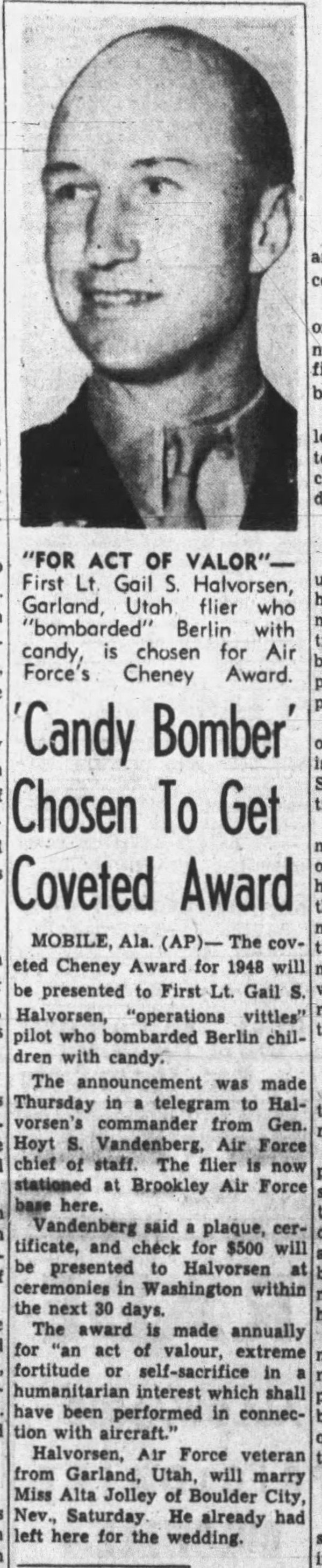
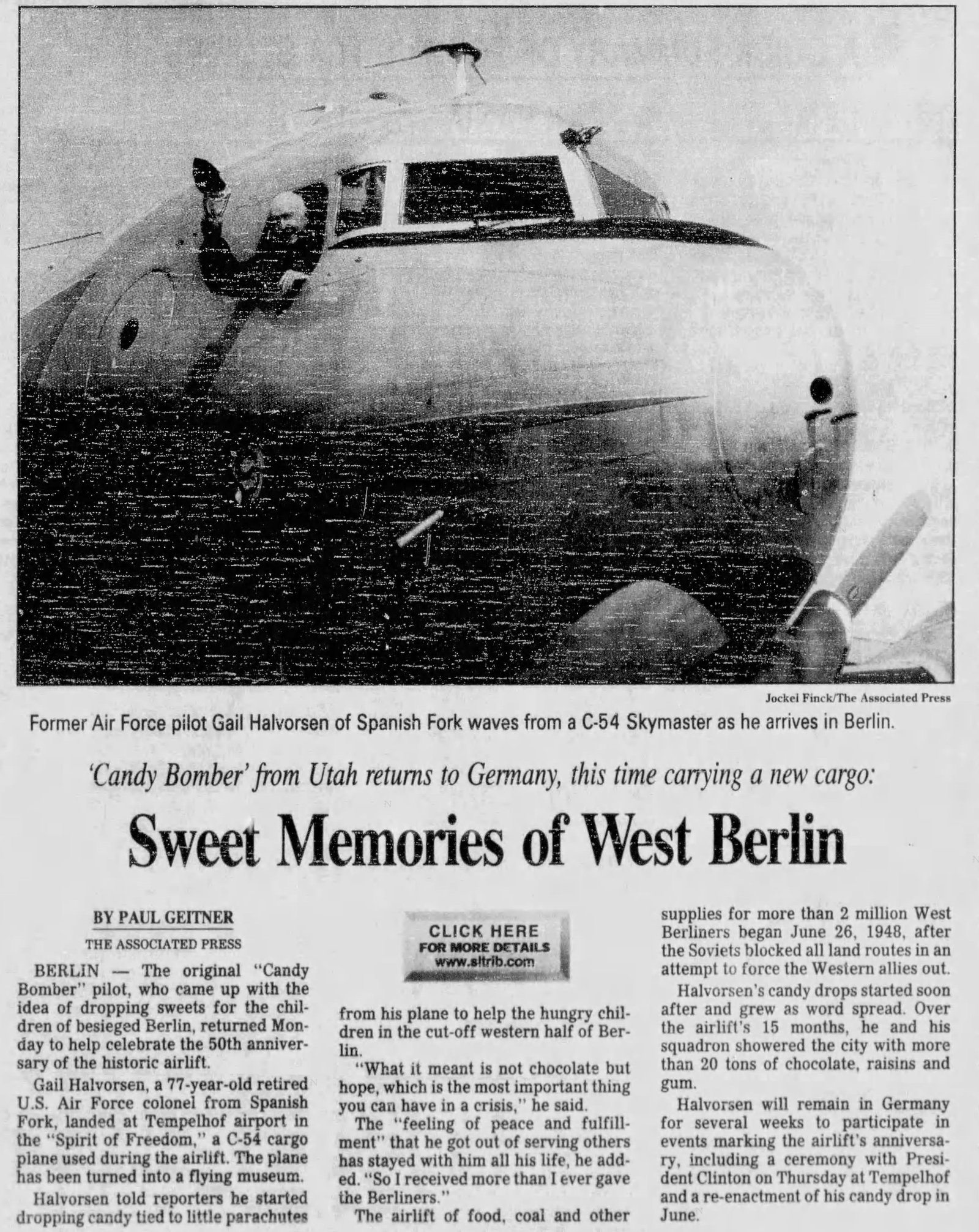
When we were living in Idaho I learned a little bit about World War II veteran and local hero Gail Seymour Halvorsen. Halvorsen was actually born in Salt Lake City in 1920 and called Utah home, but for part of his childhood, he lived on a farm in the small community of Rigby, Idaho. With a whopping population of just under 3000 souls, Rigby was the closest big town to our tiny little town of Ririe, Idaho. Considering we also had a Utah connection - we lived in Utah for part of a summer and I had visited Salt Lake City several times - I vowed to learn more about this incredibly interesting man. But, alas, I did not, and as time passed, other things moved to the front of my brain and Gail Seymour Halvorsen moved to the back. He moved so far to the back that eventually I completely forgot all about him.
Then, during our summer in Delaware, I ran smack into him again. We visited the Air Mobility Command Museum at the Dover Air Force Base, and there, right in front of me, was a giant display all about Gail Seymour Halvorsen. That was a pretty impressive reminder, the giantest of hints, a shove instead of a nudge. Here, finally, is his story:
Gail Halvorsen was a WWII Army Air Forces pilot. He got his private pilot's license through the Civilian Pilot Training Program in 1941 and joined the Civil Air Patrol shortly thereafter. (As per usual, my mind spun off down a rabbit hole and I learned a lot about the CPTP and the CAP. That information isn't pertinent to this story, but I encourage anyone interested in our nation's preparation for and response to that global war to do a little research of their own.) Halvorsen joined the United States Army Air Forces in May, 1942 and after some additional training, he was assigned to transportation duties in the South Atlantic Theater until the end of the war in 1945.
After the war, Germany was divided into two countries. East Germany became a satellite of the Soviet Union under the dictatorial control of Stalin, while West Germany, under the tutelage of the United States, France, and Great Britain, became its own free government. The problem, though, is that the capital city of Berlin, divided into East Berlin and West Berlin, was situated in, meaning completely surrounded by, East Germany. Stalin used that geographic advantage to put a choke-hold on West Berlin. His plan was to eliminate all access to food and other supplies by simply preventing transit through East Germany. The idea was that the starving and demoralized people of West Berlin would surrender their freedoms and the city of Berlin could then be made whole under East German rule. But not so fast, there, Stalin. The Western Allies said, "Nope, not gonna happen that way" and Operation Vittles (aka the Berlin Airlift) began. For almost a year (June 1948 to May 1949) the Western Allies brought much-needed supplies into West Berlin by air, eliminating the need for ground transit across East Germany. At the end of the war, our guy Gail Halvorsen decided to make the military his career, and his proficiency in flying the C-54 transport plane made him the perfect choice for supply transport into West Berlin.
Halvorsen admitted having mixed feelings about this particular mission. Germany had been the enemy in World War II and helping the enemy, especially when so many of his bretheren-in-arms had been wounded or died, just seemed wrong. On the website thecandybomber.org, Halvorson said, "One of my fellow Airlift pilots had bombed Berlin during the war. I asked him how he felt about flying day and night on behalf of the enemy, the very ones who did their best to kill him as he flew over Berlin in 1944. He hesitated a moment, shuffling his feet and then said, 'It feels a lot better to feed them than it does to kill ’em.'" So, Halvorsen and the others did their mission as they were assigned to do, bringing supplies into the bombed-out city of West Berlin so that its citizens could survive as a free people.
Like many of the pilots, he spent what little free time he had at the Tempelhof Airport in West Berlin. One particular afternoon in July, he noticed German children hanging around the airport fence and wandered over to chat with them. His attitude about the mission changed because of these children. They thanked him, then begged him to please not to give up on them becuase if they lost their freedom, they said, they would never get it back. He reached into his pocket to share his packet of gum with the children, but realized he only had two pieces left. The children broke up the gum and shared it, and the ones who didn't get any went as far as to sniff the gum wrapper. As a child of the Great Depression, Halvorsen saw some of himself in these kids, and made them a promise on the spot. He told these German children to watch the planes on approach the following day. He told them that the one with the waggling wings would be his, and that he would drop enough candy for everyone.
That night, Halvorsen and his two crewmates pooled their candy rations & made three tiny little parachutes from handkerchiefs. The next day, he did exactly what he said he would do. It wasn't much, but it was enough. The next week, he got candy rations from all the pilots and crew members and did it again. And the next week, he did it again. The Associated Press got wind of these unauthorized candy drops and when their story "Lollipop Bomber Flies over Berlin" ran in many of the nations newspapers, candy and handkerchief donations poured in from the United States. Instead of chastising him for running his own unauthorized mission, his superiors jumped on the bandwagon. On September 22, 1948 the candy drops officially became their own mission, named Operation Little Vittles, and other pilots were eager to participate. U. S. confectioners and candymakers got behind the effort in a big way. Halvorsen was quickly overwhelmed with the volume of candy, gum, and handkerchiefs coming in from the United States. In November, 1948 college student Mary Connors from Massachusetts volunteered to spearhead the project domestically and took charge of a crew of volunteers who ultimately prepared over eighteen tons of candy & tied over 200,000 little handkerchief parachutes. The candy drops became more frequent (every other day) and even though Halvorsen himself was sent home in January, 1949 his candy drop lasted until May 13, 1949. (Note: Stalin called off the blockade on May 12, 1949 but the Allied supply transport continued in some measure until September 30, 1949.)
Approximately 2.3 million tons of fuel, food, medicine, and other supplies were delivered to West Berlin during Operation Vittles. Approximately twenty-three tons of candy and gum were delivered to the children of West Berlin in Operation Little Vittles. Operation Vittles saved the lives of the people of West Berlin, and Operation Little Vittles brought joy back into a war-torn, demoralized city. No small feats, either of those.
Halvorsen went on to have a stellar thirty-one year career with the Air Force and a second ten-year career at Brigham Young University. After his return to Utah in 1949, he received a permanent commission with full pay and went to school on the GI Bill. He graduated with a bachelors degree in Aeronautical Engineering in 1951 and went on to receive his masters degree in 1952. He used his education in various locations and on various projects as assigned by the Air Force, including work in America's space race of the 1950s & 60s. In September, 1969 he returned to Tempelhof Airport for the twentieth anniversary celebration of the Berlin Airlift. There, he reenacted one of his candy drops for the 40,000 in attendance, many of whom were children at the time of the original candy drops. In February, 1970 he again returned to Tempelhof Airport in Berlin, this time as Commander of the 7350th Air Base Group. While there, he earned a second masters degree in Guidance and Counseling. His final assignment was back home in Utah, at Hill Air Force Base. Halvorsen retired from the Air Force as a Colonel in 1974. But in 1976, he put his Guidance and Counseling degree to use as the Assistant Dean of Student Life at Brigham Young University in Provo. He kept that position until he retired for the second and final time in 1986.
When he returned to Tempelhof yet again for the fortieth anniversary celebration in 1989, Halvorsen realized he wanted to do real candy drops, not just celebratory reenactments, in places where they might do some good. At that time, he told CNN, "The Airlift reminded me that the only way to fulfillment in life, real fulfillment, is to serve others. I was taught that as a youth in my church, and I found when I flew day and night to serve a former enemy, that my feelings of fulfillment and being worthwhile were the strongest that I’ve felt.” So in 1994, during the Yugoslav Wars, he convinced the Air Force to allow him to drop hundreds of candy bars over Bosnia and Herzegovina as part of Operation Provide Promise. Then in 1999, he did an even larger candy drop over Kosovo. And, although he did not fly them himself, he was heavily involved in similar drops over Baghdad in 2003 and 2004.
In his lengthy military career, Halvorsen received many, many medals, citations, and awards. And for his attitude of service and compassion, he has received many, many civilian accolades and acknowledgments. The most notable of these, in my opinion, are the Cheney Award for humanitarian action, given to him by the Air Force in 1949 and the Grand Cross of the Order of Merit of the Federal Republic of Germany (Germany's highest award) given to him by the country of West Germany in 1974. The Air Force has named an aircraft loading vehicle after him, and has created an award in his honor. He even has schools in Germany named after him. In his many visits to Berlin and in the years he was stationed there as commander, he had the opportunity to meet and get personal messages of gratitude from many of the children, now adults, who received candy from him. I think my favorite acknowledgment of him, though, is when he was given the honor of carrying the German national placard in the opening ceremony of the 2002 Winter Olympics in Salt Lake City.
In 2016, Halvorsen, his daughter Denise Williams, and a friend James Stewart formed the Gail S. Halvorsen Aviation Education Foundation (later renamed The Candy Bomber Foundation) to promote aviation and STEM (Science, Technology, Engineering, and Mathematics) education. In 2019, Halvorsen visited Germany for the final time. He was just a month shy of his 99th birthday when he flew in the seventieth-anniversary celebration. He was 101 years old when died in Provo, Utah in February, 2022.
Gail Halvorsen is quoted (from his website) by Lee Benson in the Deseret News on February 17, 2022: "In man’s search for fulfillment and happiness, material rewards pale compared to the importance of gratitude, integrity and service before self. [It] is the only true recipe by which full fulfillment may be attained in this life. It is one of the core values of the United States Air Force. Today the Air Mobility Command, in the Airlift tradition, launches a mission of mercy every 90 seconds somewhere around the world. The American flag on the aircraft tail is the symbol of hope to those in deep despair from whatever the source of oppression." When asked the secret of having along life, he is quoted in a Deseret News article from October 4, 2020: “Always have something to do, and watch for things you can do that make a difference.” He is quoted by Paul Geitner in the Salt Lake Tribune on May 12, 1998: “What it means is not chocolate, but hope, which is the most important thing you can have in a crisis.” On the website thecandybomber.org, Halvorsen is credited with saying, "My experience in the Airlift taught me that gratitude, hope, and service before self can bring happiness to the soul . . . " Those were damn fine words to live by, Gail, and I wish I could've thanked you for your service.
.JPG)
.JPG)
.JPG)
.JPG)
.JPG)
.JPG)
.JPG)